

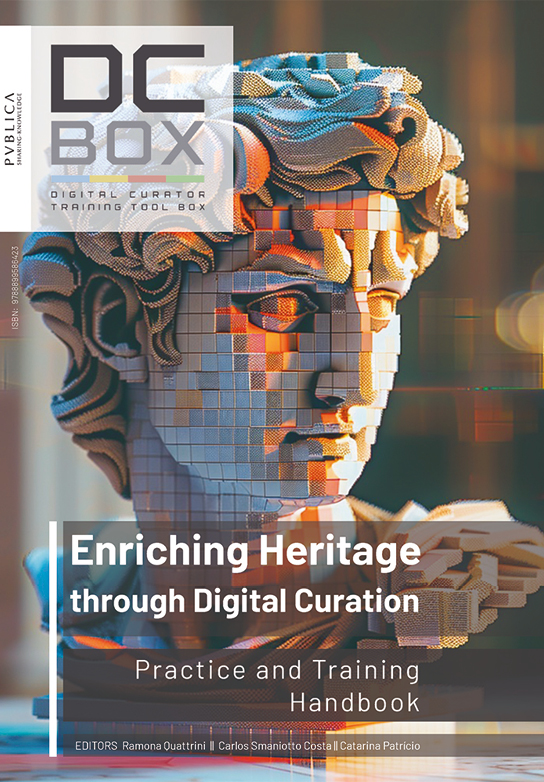
Enriching heritage through digital curation.
PRACTICE AND TRAINING HANDBOOK
A cura di
Ramona Quattrini, Carlos Smaniotto, Catarina Patricio
Anno
2024
ISBN
9788899586423
DOI
10.82048/202404
This book aims to showcase the major achievements of the project DCbox, that investigated the figure of digital curator, for 30 months. It offers a comprehensive analysis of the current landscape of professional skills in Cultural Heritage, delineating existing needs and emerging trends. Additionally, it outlines the design of the DCbox learning approach for the 4 Digital Curator skill set, which encompasses various competencies and learning objectives. The book elucidates, from both theoretical and practical perspectives, the implementation of the MOOC titled ‘Supporting the Digital Transformation of Museums: The DCbox Approach’. Moreover, it provides in-sights from proactive learning experiences within the Living Labs, where diverse prototypes of curatorial practices were explored, ranging from virtual reality to storytelling, gamification, and online digital collections. These Living Labs, established in each participating university and beyond, with the involvement of new associated partners, ensure the project’s sustainability and underscore the creation of a community. The handbook outlines all these outcomes methodologically, while also offering perspectives from learners and tutors engaged in the framework. In particular, the essay section is devoted to frame the activities of the project in a larger and cross-disciplinary scenario as well as it serves as a thought-provoking exploration into emerging trends and paradigm shifts in the relationship between all the emerging technologies and cultural heritage.
The present handbook represents the result of the project: the role of the digital curator was clarified as situated within the broader framework aimed at equipping museum professionals with adaptive competencies. Emphasising the importance of long-term viability, ethical conduct, and community involvement, this project and similar initiatives seek to enhance the resilience and efficacy of museum practices in an ever-evolving digital landscape. A secondary goal of the DCbox project was to investigate virtual tools in educational practices and various remote learning activities, aiming to develop a pertinent and up-to-date training curriculum for digital curators while also providing a new toolbox for these emerging Euro-pean professionals. Specifically, the project activities were directed towards addressing the lack in university training programs that are oriented towards the ‘learning by doing’ model within virtual classrooms. This gap of virtual tools able to bridge the theoretical framework provided to students and the essential practical experience required for concept reinforcement was a focal point of the project’s efforts.